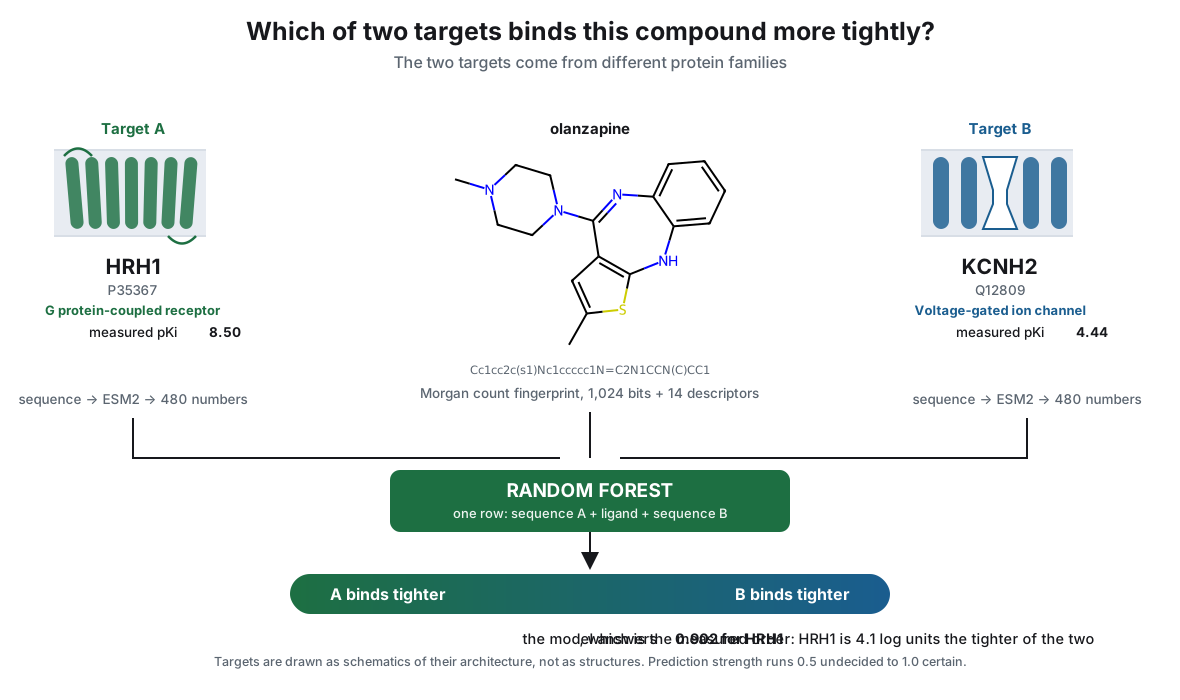
Given one compound and two targets from different families, which binds it more tightly
One model, one question. It returns a probability, never an affinity and never a predicted Ki.
Model built 13 September 2026 on 89,888 cross-family comparisons over 22,588 ligands and 1,879 targets, from ChEMBL 37 alone. Methods.
What it is for
Off-target triage and repurposing. Give it a compound and a set of targets drawn from different families, and it ranks which the compound leans toward. The sibling models each compare within one family; this one crosses the boundary.
What it scores
Held-out accuracy over comparisons the model never saw, on a compound-disjoint split: a ligand lands on one side only, and no ligand appears on both.
Accuracy
0.750over 8,689 held-out comparisons on 2,195 ligands
Targets
1,879across 38 protein families
The two baselines, beside the headline
A cross-family comparator can look respectable while knowing nothing about the compound, because some families simply bind more tightly than others. So the honest question is not what the model scores, it is how much better it does than knowing only which two families are involved.
| What is being asked | Accuracy |
|---|---|
| The model | 0.750 |
| Always pick whichever family usually wins that pairing | 0.654 |
| The same forest with the ligand removed | 0.710 |
The compound itself contributes about four points on top of target identity. That margin held across three independently built versions of this model, at 3.9, 4.5 and 4.1 points. It is real, it is reproducible, and it is smaller than the headline number on its own suggests.
Read the strength, not the ranking
Strength is the larger of the two returned probabilities, so it runs from 0.5, a coin flip, to 1.0. Accuracy rises with it and coverage stays usable.
| Strength at or above | Share of comparisons kept | Accuracy |
|---|---|---|
| 0.50, answer everything | 100.0% | 0.750 |
| 0.60 | 74.4% | 0.815 |
| 0.70 | 52.0% | 0.877 |
| 0.80 | 35.9% | 0.933 |
| 0.90 | 22.1% | 0.966 |
A near-tie is a near-tie
Accuracy depends on how far apart the two measured values really are.
| True separation | Comparisons | Accuracy |
|---|---|---|
| Under half a log | 2,283 | 0.573 |
| Half a log to one log | 1,766 | 0.701 |
| One to two logs | 2,359 | 0.797 |
| Beyond two logs | 2,281 | 0.915 |